
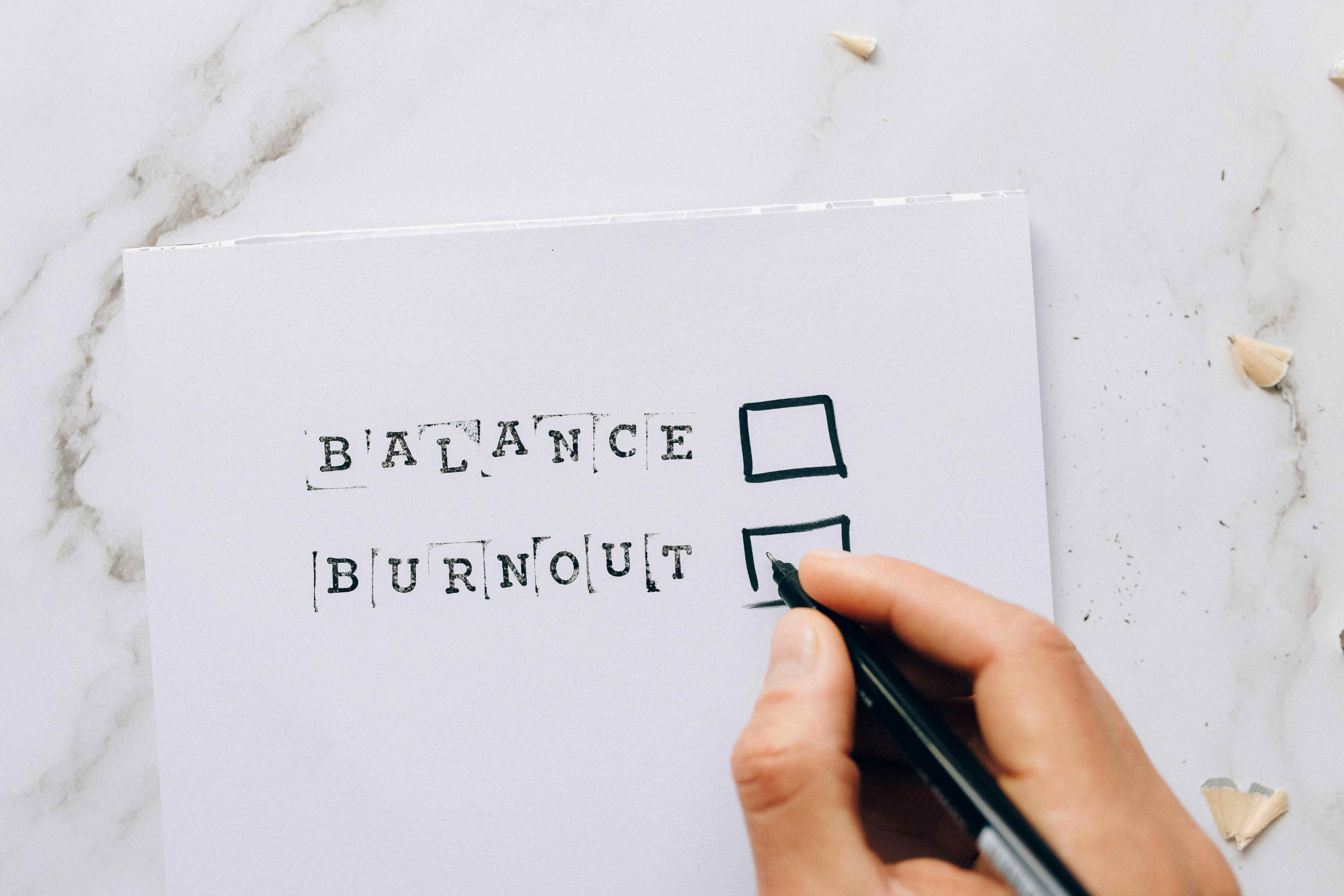
Photo by Nataliya Vaitkevich on Pexels
Overwhelmed, exhausted, or running on fumes? Discover why burnout happens, how to know when you’re stuck in the stress cycle, and the surprising ways music can help you find your way back to balance.
Guest
It is officially December and “the most wonderful time of the year”! The holidays can be wonderful… and they can also be a lot. This is a time of year when a lot of us are feeling overwhelmed, stretched thin, maybe running on fumes, whether because of academic finals, complicated family dynamics, end-of-year deadlines, or just the pressure to “make the season magical” for a young family. And regardless of when you’re listening to this episode – right when it releases or another time of the year – stress and burnout are common realities in today’s culture.
Today’s guest doesn’t just understand burnout; she literally co-wrote the New York Times bestselling book on it. And she’s a musician. Dr. Amelia Nagoski is here to share what burnout really is – and how music offers practical, science-backed ways to complete your body’s physiological stress cycle and restore your sense of balance. Dr. Nagoski is a conductor with a Doctorate of Musical Arts who teamed up with her identical twin sister Emily, a PhD, to write the New York Times bestselling book, Burnout: The Secret to Unlocking the Stress Cycle.

Notes
We discuss:
- What burnout really is, how common it is, and the three components that define it: emotional exhaustion, depersonalization, and decreased sense of accomplishment.
- The story behind the book Burnout and how Amelia Nagoski’s personal experience – and her training as a musician – shaped her understanding of the stress cycle.
- The crucial difference between stressors and stress, and why completing the body’s physiological stress cycle is key to well-being.
- Why we get “stuck” in stress, and how chronic stressors, social expectations, and safety concerns interfere with healthy emotional processing.
- Practical, research-backed ways to complete the stress cycle, including physical activity, breathing, positive social connection, and creative expression.
- How music – whether singing, listening, or creating – can help us move through emotions and complete the stress cycle.
- Why musicians, educators, parents, and caregivers are especially susceptible to burnout.
- Special input for musicians on burnout prevention and recovery, and why Amelia says that the biggest lie for musicians is: “Do what you love and you’ll never work a day in your life.”
- How to recognize when you’ve completed the stress cycle (“I feel incrementally better than when I started”).
- A powerful reframe: wellness isn’t constant calm – it’s the ability to move fluidly between challenge and safety without getting stuck.
- Super-charged “magic tricks” for burnout recovery.
- Some of Mindy’s favorite quotes from Amelia’s book:
To be “well” is not to live in a state of perpetual safety and calm, but to move fluidly from a state of adversity, risk, adventure, or excitement, back to safety and calm, and out again. Stress is not bad for you; being stuck is bad for you. – Amelia Nagoski & Emily Nagoski, Burnout
[The arts] create a context that tolerates, even encourages, big emotions… literary, visual, and performing arts of all kinds give us the chance to celebrate and move through big emotions. It’s like a cultural loophole in a society that tells us to be “nice” and not make waves. Take advantage of the loophole. – Amelia Nagoski & Emily Nagoski, Burnout
Connect/Other Resources
- The book: Burnout: The Secret to Unlocking the Stress Cycle, by Amelia Nagoski, DMA & Emily Nagoski, PhD
- Website: https://www.burnoutbook.net

Other episodes we mentioned or that you may enjoy:
- Ep. 219: The Hidden Resource for Stress Relief, Connection, and Resilience – How Orchestras Are Quietly Transforming Community Well-Being; with Karen Yair, PhD
- Ep. 36: Mental Skills for Stress Reduction and Peak Performance, with author Dr. Vanessa Cornett
- Ep. 179: How We Human – Fostering mental wellbeing specifically for creatives; with Tasha Golden, PhD
- View all episodes related to Science & Health
In-Episode Promo
LIVING WELL WITH DR. MICHELLE: I’m always looking for the best ways to support holistic health and wellbeing, through music… and beyond. So when I learned about all-natural products created by a holistic, biologic dentist, I had to try them out! Did you know that chemicals in commercial mouthwash and toothpaste can be absorbed through your oral tissues even if you don’t swallow the product? One of my favorite Living Well with Dr. Michelle products is the Remineralizing Mouthwash. It’s alcohol-free, so it won’t dry out your mouth, and instead of harsh chemicals, it uses colloidal silver to help balance oral bacteria. It’s infused with peppermint oil to freshen your breath naturally, and it contains hydroxyapatite – the very mineral your enamel is made of – to support strong teeth and reduce sensitivity. I also love their Sensitive Remineralizing Tooth Powder, but I couldn’t resist trying their brand-new Toothpaste. It’s not officially labeled for sensitivity, but it’s made with micro-hydroxyapatite which many people, myself included, find reduces sensitivity. For natural, effective oral care products – and 10% off – go to livingwellwithdrmichelle.com and use Coupon Code: musicenhances10. (Link is in the show notes; or buy on Amazon.)
Coda
Amelia shares both a story and song about what she calls the Uber Bubble.

Closing Words
Thank you to Dr. Amelia Nagoski for sharing these insights on burnout and how music can be utilized as a strategy for moving through the physiological stress cycle to prevent or heal from burnout. I hope this conversation gave you a greater understanding of the science behind emotional exhaustion and some practical tools for finding your own best ways to move yourself through the tunnel of stress or other emotions so you can emerge on the other side rather than getting stuck.
There’s a link in the show notes to Amelia’s book, Burnout: The Secret to Unlocking the Stress Cycle. And I’ll also include a link to a song that I found especially helpful this time of year when my kids were young – that’s when I really felt the holiday stress because of all the extras that parents are trying to do around the holidays: shopping, decorating, baking, traditions, making magical memories for their kids. During this stage, I especially loved the song “I Need a Silent Night,” by Amy Grant and I’d listen to that on repeat to calm myself down before bed.
You can always connect with me on email (mindy@mpetersonmusic.com), Facebook, Instagram, X, or LinkedIn; and by signing up for my monthly e-Newsletter.
Thank you so much for joining me today. Until next time, may your life be enhanced with music.
If you enjoyed this episode, please:
- Follow us in your podcast app: This is FREE and conveniently delivers each new episode to your device when it releases, so you don’t have to search for it.
- Share us with others: If you know of someone who would enjoy this episode, please share it with them! It’s easy to do right in your podcast listening app. Just tap the Share feature for options to share by text, email, or social media (or share this page).
- Rate & review our show: This fuels our creative energy, and also helps others find the show!
Note: We occasionally use affiliate links for products and services we whole-heartedly believe in. We may receive a small commission, at no extra cost to you, for purchases made through these links. This helps support the free content we provide.
3 responses to “Ep. 223: The Science of Burnout & the Musical Tools That Heal It; with Amelia Nagoski, DMA”
[…] Ep. 223: The Science of Burnout & the Musical Tools That Heal It; with Amelia Nagoski, DMA […]
[…] everything extremely personally.” (If this resonates with you, you’ll want to listen to Ep. 223 on the Science of Burnout with Dr. Amelia Nagoski, as she also has a lot to say about this […]
[…] Ep. 223: The Science of Burnout & the Musical Tools That Heal It; with Amelia Nagoski, DMA […]